Sunday, 1 June 2014

Free machine embroidery

This week I have also learnt how to do free machine embroidery. Free machine embroidery is when you draw freely onto fabric with your sewing machine. First for this process you need to set your machine up correctly (I used a husquvana viking). You have to take the pressure foot off of your machine and turn the feed dogs off. Then you need to get a piece of material that you will be sewing into, I used a A4 piece of calico. 

Then with your material you need to put it into a embroidery hoop making sure there is a lot of tension. You are now ready to start sewing.

This is a dangerous technique so when you start sewing keep your fingers on the embroidery hoop so that you won't get your fingers caught with the needle.   

My sample

My piece that I created was a quick sample and I tried to make some flowers. They look okay for a first try and I tried stitching sections in fully however I think I need a lot more practice. 

Close up of sample

It is a very spontaneous technique and mistakes are inevitable but that is what makes the technique so appealing. When you don't have as much control over the machine it makes your work more free and rough and I like how it makes my work look.

Quilting

This week I have been learning a new process called quilting. Quilting is a process where you sew two or more pieces of material together with a pattern or design to make a thick padded material. First for my sample I had to get two A4 pieces of calico and a A4 piece of wadding as seen below.

Calico and wadding

Then on one piece of calico I drew a line in the center and on one half I drew a straight line pattern and on the other I drew a diagonal line pattern. Next I put the wadding in between the two pieces of calico and put pins on the pieces to keep them together and straight.

All I had to do then was sew with the sewing machine over the lines I had drawn on making sure the material didn't fold over or get caught.

My sample

This was my finished sample and it was very successful. at the end of each stitch I used the back stitch so that the cotton didn't unravel and this made it look tidy. It is a fun process and it is quite simple to do. It would be a great process to use for my final piece because of the simple but effective pattern.

Sunday, 11 May 2014

Peg loom weaving

In my textile workshop this week I did some peg loom weaving and it was a really therapeutic process. 

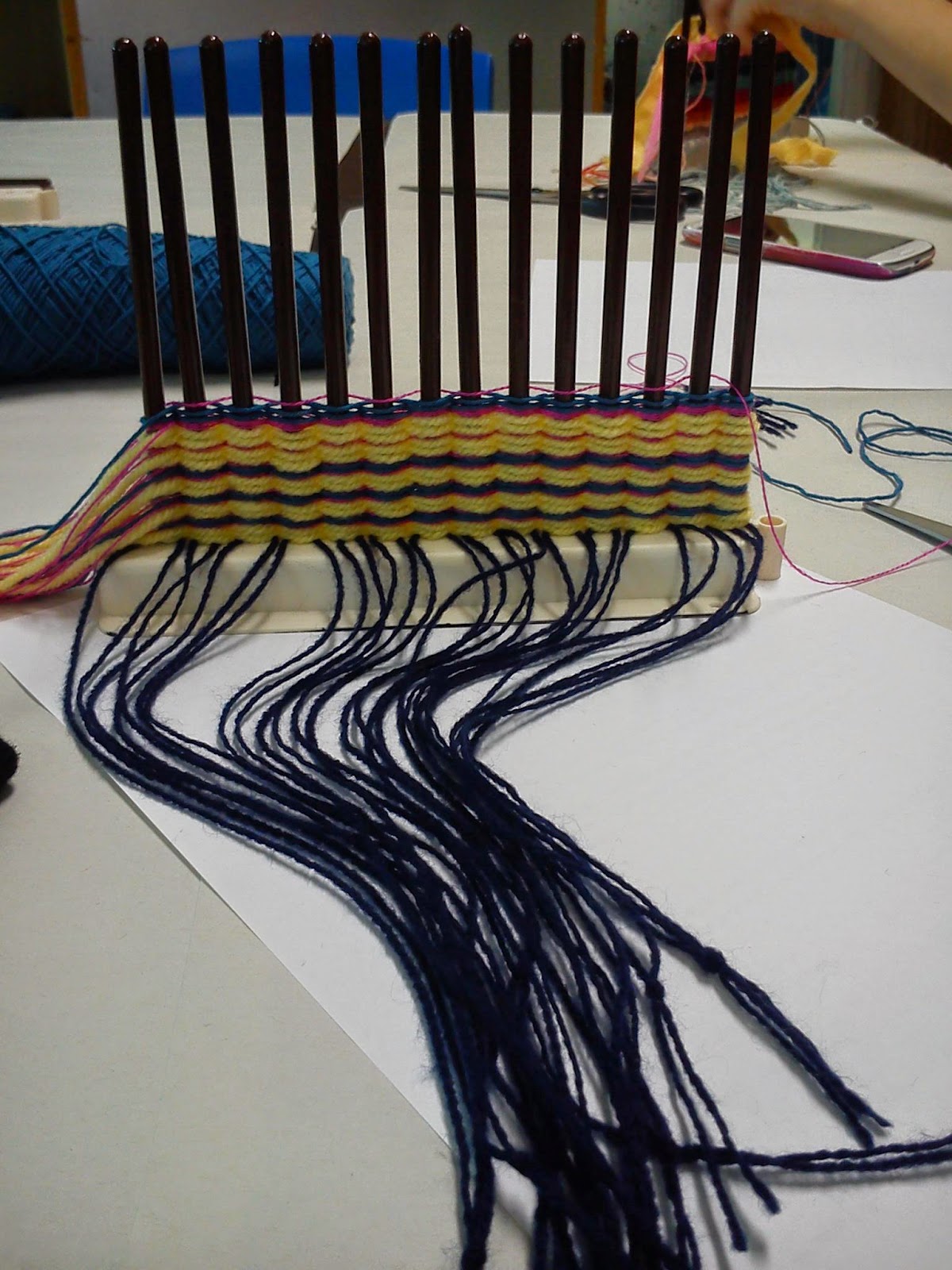
Peg loom weaving 

First for peg loom weaving you have to cut some lengths of cotton that are exactly the same size for each peg you have. Then take the cotton and thread it through the bottom of the peg where there is a hole making sure to pull it through so both sides are equal. Do this for each peg and put it in the base of the peg loom. Then you tie a knot with the first 3 strands of cotton and then every 2 after that making sure it is from a different peg. Also make sure the knots are in the same place as each other so the final product won't be wonky. 

Then you can start weaving through the pegs. Make sure you leave some material at the end to tie off with and when you come to the end of the peg loom remember to weave the opposite way. 

When your peg loom is full you pull each peg out of the base through the part you have weaved and then put it back into the base on the outside. Once you have done this you have to move the part you have weaved down the strands of cotton by pulling it slowly. Then you can keep doing this until you are ready to finish your piece. 

Once finished cut the cotton as close to the pegs as possible and then tie the strands off so it doesn't come undone. Then the cotton ends that have been woven stick to the back of your piece using masking tape. You are now finished.

My peg loom weaving 

The above picture is of my own peg loom weaving that I managed to make during my workshop. It was inspired by one of my backgrounds I did in my sketch book. I am pleased with how it turned out in the end and I am thinking about using the process for my final piece at the end of my project. Its a relaxing process but not everyone likes it, luckily I do. It is different to the processes than what I am used to but you can make fun colourful patterns with it and I really love it.

Sewing machine lesson

This week in my textiles  I have had a basic lesson on how to use a sewing machine. First I was given a sewing machine that I would be using I had the machine called brother STAR 40E.  

Brother STAR 40E

This machine was quite easy to use when you learnt how to handle it and it wasn't too complicated to find the buttons to set it up. 

To set up the machine I had to check the stitch sectors, the stitch width dial, the stitch length adjuster and the needle position. The stitch sectors are found at the top of the sewing machine and it is a panel that shows you all the different stitches your machine can do and is able to chose whichever stitch you want. If you want a straight stitch you use 0 if you want the zigzag stitch you use 1. The stitch width dial is found at the front of the machine and controls the width of your stitch. Then the stitch length adjuster controls the length of the stitch and is normally set at 2. The needle position is in the center of the stitch width dial and it changes the placement of the needle and it is set at 0 for a normal stitch. 

Parts of a sewing machine

After checking these settings I started sewing on some practice sheets without any cotton in it so that I could try to control where I was stitching. 

   
Practice sheet 1

This sheet was pretty simple and I learnt that if you leave the needle in and lift up the pressure foot you can turn the material so it carries on sewing in a different direction. 

Practice sheet 2

Then I did a second practice sheet that was a little harder and I thought I did well with this one even though I spent more time on this one.

Then I was told about the reverse button that makes you go back over the stitch to secure the thread when you come to the end to make sure the stitch doesn't unravel. And the feed teeth that are found under the presser foot and they grip the fabric and help move the fabric flatly while you are sewing.

After this I then learnt how to put the bobbin into the machine and how to put the thread on the spool. My bobbin was simple to set up all I had to do was take the shuttle cover out, slot the bobbin in and then follow the arrows round with the thread from the bobbin and put the cover back on . Then the spool for the top was put on the spool pin and then I followed the arrows with the thread up around the take up leaver and the thread guides and then down to thread it through the needle. 

Then I had a go sewing with some material and thread and changing the type of stitch I was using.

Sheet with different stitching

I really enjoyed my first sewing lesson and had fun trying to do the practice sheets. Altogether I think I did well with learning the basics although I am still not sure on some things but I'm glad it has gone well.

Monday, 7 April 2014

Nature Evaluation

The main focus of this project was nature and I had to research this topic to make a textile design that had been developed throughout my work.

First I did some research by doing observational drawings of a still life set up. For this I used different medias, and other techniques with a time limit on how long I had to draw the set up. I did four observational drawings altogether.  The first one was on blank A3 paper and was a line drawing with a HB pencil, I had fifteen minutes to draw it.  The second drawing was on A4 paper drawn with a biro pen and using my left hand, with a time limit of five minutes. The third drawing was on black A3 paper drawn with a white soft pastel I also had fifteen minutes to draw it in. The fourth drawing was on A4 paper but I made the paper textured by putting bits of masking tape on it and crumpling the page up.  Then using a black felt tip pen I drew the still life set up, I had about twenty minutes to do this one in as I had to prep the paper. These went quite well as it shows my exploration of line and scale however I believe they would be better if given more time to finish them.

Other research I did involved doing two moodboards, a primary and a secondary one both looking at nature. The secondary moodboard was based on images that I found from a secondary source this been the computer and magazines and I did some critical studies of these images. The critical studies in my opinion helped me to explore pattern and texture. For my primary research I did two sheets filled with pictures I took myself when I visited the zoo this was good because I got to photo close ups and collage them together. In addition to these sheets I did a sheet of ideas for my ceramics workshop, a sheet on animal print samples and two sheets on two well-known textile artists. 


Secondary research sheet

After completing these research sheets I began to develop my research by making two visual sheets. These visual sheets had ideas from my research sheets that had been combined together to make patterns and designs that I could then use to inspire my design for my final piece. I looked at what other textile artists did and what ideas from their work I could take forward to help me with my own designs.


Visual sheet - one


Part of visual sheet - two

The main ideas that I took forward into my designs were the silhouettes of animals and insects because when I put a few together they made a nice pattern. I decided to use the animal pattern leaf idea because it is original and unique and I used some floral ideas that were influenced by the designers I chose to look at as they do lots of floral prints.

I encountered quite a few problems when doing my designs these mostly been that the designs would not fit together if I used the ideas I had. Or that the shapes I was going to use were too big and would not fit in with the other part of the design. When this did happen I had to either rethink the design or make the shape smaller to fit in with the rest of the design. It was quite difficult learning the new technique of how to do a repeat pattern but I soon got the hang of it by drawing quick designs and testing other peoples designs. I also had a problem with the amount of time I was given to do the sheets within class however I overcame that by putting the time in at home.

The textile designers I chose to look at when doing this project were Laura Ashley and Cath Kidston. I chose these designers as I thought they linked to to my work the most as they use floral patterns and animal patterns within there own designs. As I was also looking at animals and flowers I thought it would be great to look at these artists so I would be able to use them to influence the set up and ideas in my work. For example in some of Cath Kidstons recent work she uses giraffes and I also used this idea but made it my own by using silhouettes and incorperating the pattern of the giraffe onto leaves or flowers. The artists influenced my work alot through the designs as some of the textures and patterns were inspired from there work however I did not incorperate there  exact designs anywhere in my work as I wanted to come up with my own patterns.

For my final design I made two repeat patterns. I chose to do two as I was curious as to how they would both turn out as they were both exciting patterns and I knew if I managed my time well I would be able to do an extra piece. To choose the designs I would do I chose my three fravourite designs and then asked the classmates on my table and my tutor to choose which one was the best in there opinion. It was at this point that I chose to do two final pieces as we could not decide between two of the designs. I thought it would be good to ask other peoples opinion of my work so that I would know that people like it and I was picking the right designs to produce.

Once I had made my final design it was quite easy to reproduce as the pattern matched up perfectly when I made other copies of the design. One of the designs was about a millimeter off but it still fit together and worked which I am very pleased about.

Throughout this project I learnt and used lots of new processes. In the ceramics workshop I learnt how to do extruding and glazing. In the textile workshop I learnt how to do batik, paper making, mark making, screen printing and puff binding. Then on my lesson on a Tuesday I did more batik and learnt how to do heat transfer with one of my visual sheets. I found these new processes very enjoyable to do and it was great to learn all these new processes through doing this project.

What I feel went well in this project would be my final designs and final pieces as they turned out exeptionally well. My research and the workshops also went well because I got to explore line, scale, texture and pattern throughout experimenting and researching. What went wrong in this project would be some of my ceramics work as I was not as experienced in this area of art. It sometimes looked unfinished and messy. If I could change anything in this project it would be the amount of research sheets and visual sheets I have done as I would have liked to develop my ideas further. I would also change some of my ceramics work and design my ideas before going into the workshop.

Overall I think I managed my time well, I tried to get the work I was set done during class time but if I failed to complete it in that time I did it for independent study. I have also done extra work meaning I have put more time into this project when I have had time during the week and on the weekends. I felt I needed to put this time in to better my work and develop all of the research I have done.

Duing this project I have also been doing a blog that I have continuously been updating on the workshops and the project. I think I have used it effectively as I have been able to write about the processes I have learnt in full detail and show how I have developed my work throughout the project. I will also be able to look back on the processes when I use them again to remember how to do them.

Altogether I think the project was very successful, all the research I undertook went well and I managed to make two final pieces that were well developed and repeat perfectly. My strengths through this project were coming up with new designs and patterns from simple pictures and experimenting with ideas to see if they work or fail. To improve the project I could have done more research and more experimentation to show I have looked and tried out new ideas. Also I need to make sure there are no negative spaces on my sheets and to annotate/explain my sheets in more detail. This is something I will take through to the next project I do. 

Sunday, 6 April 2014

Final piece

This week I made my final piece and luckily I had enough time to do two of them. I chose my two best designs to make into a large repeat pattern, I'm so happy that they do repeat and I didn't have to redo them.

Flower and flamingo print

This design is a bright and summery design and I think it would look great if it was put onto a dress. When making the print I had to cut the original into four equal squares and on this one I was about a millimeter out however I was still able to make it work.

Flower and flamingo print

In my opinion this print is simple because it doesn't have a lot of small details but its still eye catching as the vibrant colours and silhouettes jump out. 

Giraffe and leaf print

My second print is filled with detail and has lots of animal characteristics. The leaf idea was a spontaneous doodle on my visual sheet that I put there to fill up the empty space and I have developed it to become the main feature of this pattern and it looks fab. Its such a interesting pattern and the idea to use animal skin patterns with other aspects of nature is a weird but wonderful idea.

Giraffe and leaf print

This pattern also uses earthy tones and I think this makes it stick to the idea of nature because these are the colours you would expect. This is by far my favorite design but they were both successful and look amazing. 

Textiles - week 4

This week was my final week in the textile workshop and it was all about refining my work and been creative with the pieces of work that I didn't like to make them better.

My screen printing pieces

The above image is of my screen printing pieces after they had dried. I put these on because I didn't manage to photograph them last week and thought it would be worth putting them on before I worked back into them.

Developed pieces

These are the pieces that I have worked back into as I thought they looked bland and boring before I changed them. I cut some up into strips and suck them on the hand made paper and I stitched some pieces together with multicoloured cotton to make the pieces look abstract. I think these pieces look good and I like the different textures and pattern that that are in them. To make them even better I would use thicker cotton and finish stitching into my felt.  

Three favorite designs

Once finished I had to frame my three favorite designs I chose these ones because I thought they look the most striking. They are inspired by nature like bees and beehives. In this lesson I also got handouts about all the processes to keep but there are that many I am unable to blog them all but I have explained all of them in earlier posts. Hope you all enjoyed reading about textiles x